Industrial facilities and commercial complexes operate under massive thermal and electrical loads. While conventional combined heat and power systems capture engine exhaust to produce steam or hot water, many operations face an entirely different thermal demand during summer months or across continuous production lines: process cooling and air conditioning. When waste heat is dumped into the atmosphere while electricity-hungry mechanical chillers run at full capacity, overall plant efficiency collapses.
Integrating an absorption chiller directly solves this seasonal and operational imbalance. As the core cooling element within a modern trigeneration system—also known as Combined Cooling, Heating, and Power (CCHP)—absorption chillers utilize thermal energy instead of mechanical compression to produce chilled water. Understanding the thermodynamic cycle behind waste heat cooling allows operators to optimize fuel utilization, balance seasonal thermal profiles, and achieve superior overall plant efficiency.
What Is Absorption Cooling in a CCHP Architecture?
Conventional cooling relies on vapor-compression chillers driven by electric motors. In contrast, absorption cooling is a thermal-driven refrigeration cycle that replaces the mechanical compressor with a chemical absorption and desorption process.
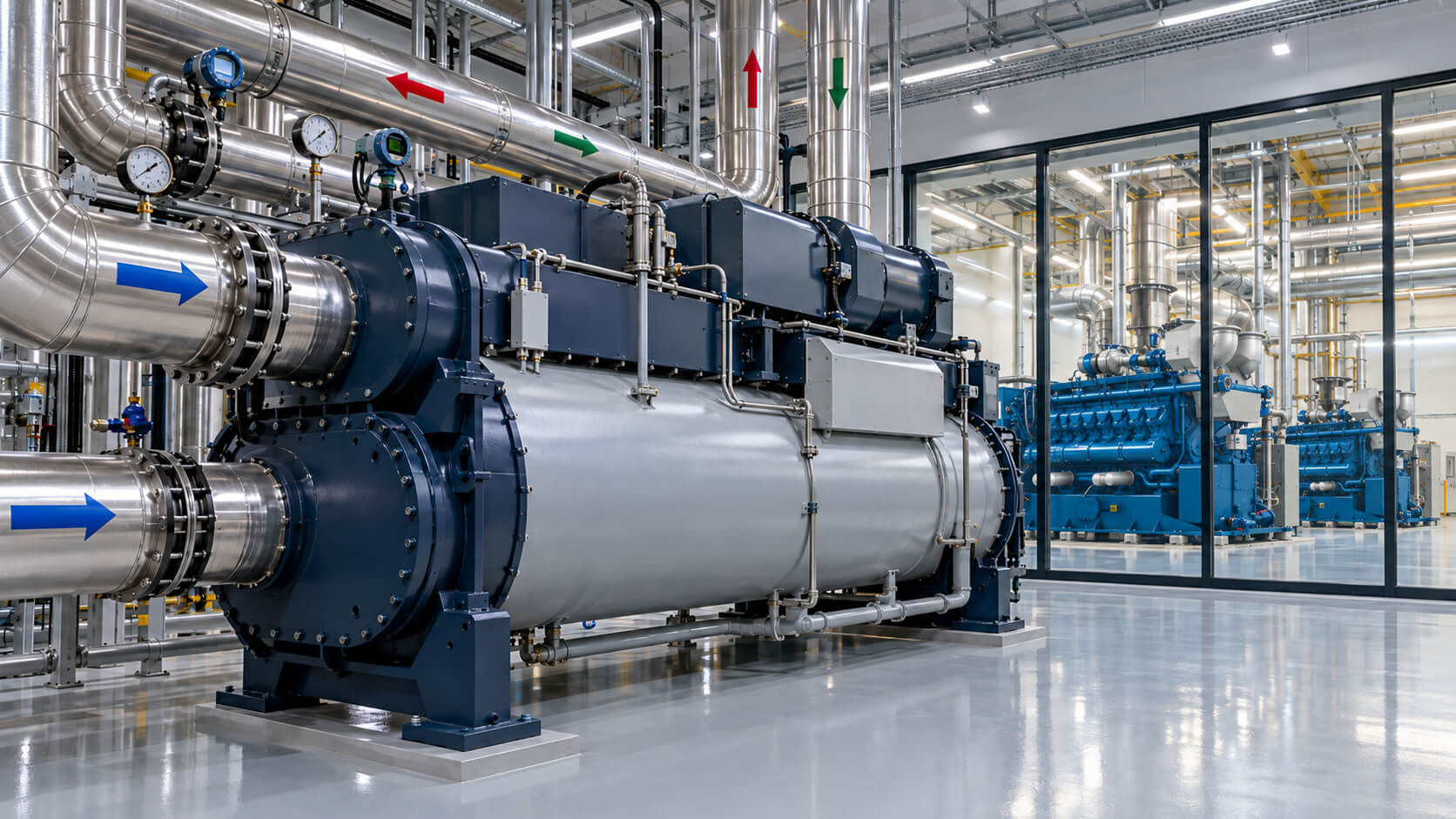
In an industrial trigeneration setup, prime movers such as gas engines generate electricity while producing significant high-temperature heat via jacket water and exhaust gases. Instead of generating cooling by drawing hundreds of kilowatts of grid power, the system routes this hot water or exhaust steam directly into the generator section of an industrial absorption unit. The result is trigeneration cooling generated directly from thermal energy that would otherwise be wasted.
The Working Principle: The LiBr-Water Thermodynamic Cycle
The dominant technology utilized in commercial and industrial trigeneration plants is the lithium bromide chiller (water-LiBr system). In this closed-loop cycle, pure water serves as the natural refrigerant, while a lithium bromide salt solution acts as the absorbent.
Because the system operates under a deep internal vacuum (roughly 1/100th of atmospheric pressure), water boils and vaporizes at temperatures as low as 4°C to 7°C, enabling chilled water generation. The continuous refrigeration cycle progresses across four primary thermodynamic stages:
1. Evaporator
Chilled water returning from the facility floor (typically at 12°C) passes through heat exchanger tubes inside the vacuum shell. Pure liquid refrigerant (water) is sprayed over these tubes. Because of the extreme vacuum, the sprayed water evaporates instantly at roughly 4°C, absorbing heat from the process loop and cooling the returned water back down to 7°C before it is pumped back to the facility.
2. Absorber
The refrigerant vapor created in the evaporator flows directly into the absorber vessel. Here, a concentrated lithium bromide solution is continuously sprayed. Lithium bromide possesses an immense chemical affinity for water vapor, rapidly absorbing the steam and turning into a diluted salt solution. This chemical absorption releases reaction heat, which is carried away by an external cooling water loop connected to a cooling tower.
3. Generator (Desorber)
To keep the cycle running, the diluted LiBr solution must be regenerated, and the water refrigerant must be separated. A low-power solution pump transfers the diluted mixture into the generator. This is where the trigeneration heat is introduced: hot exhaust gas, jacket water, or steam from the gas engine heats the solution. The heat boils off the water vapor, concentrating on the lithium bromide solution so it can return to the absorber to absorb more vapor.
4. Condenser
The hot water vapor boiled off in the generator flows into the condenser chamber. Cooling tower water flows through condenser tubes, cooling the vapor until it condenses back into liquid water. This pure liquid refrigerant then flows through an expansion device back into the evaporator, completing the closed thermodynamic loop.
Absorption Chillers vs. Electric Chillers: Technical Comparison
Evaluating an industrial cooling system requires examining the core mechanical differences between thermal absorption and electrical vapor-compression:
|
Feature / Metric |
Absorption Chiller (Thermal) |
Electric Vapor-Compression Chiller |
|
Primary Energy Source |
Waste heat (Hot water, steam, exhaust) |
High-voltage electricity |
|
Refrigerant Type |
Pure water (Zero GWP, Zero ODP) |
Synthetic HFCs / HFOs |
|
Core Mechanism |
Chemical absorption (LiBr + Water) |
Mechanical compressor |
|
Electrical Consumption |
Minimal (Only fractional solution pumps) |
Very high (Heavy compressor motor load) |
|
Moving Parts & Wear |
Extremely low (No high-speed rotors) |
High (Pistons, screws, or impellers) |
|
Noise & Vibration |
Near-silent, vibration-free operation |
Noticeable acoustic and vibration output |
|
Coefficient of Performance (COP) |
0.7 – 0.8 (Single-effect) / 1.1 – 1.4 (Double-effect) |
3.5 – 6.0 (Electrical COP) |
While electric chillers show a higher numerical coefficient of performance, they consume expensive electrical power. Absorption chillers derive their energy from free, on-site recovered heat, transforming a thermal waste stream into a direct replacement for grid-dependent electric compressor loads.
Integrating Absorption Cooling into Trigeneration Facilities
Deploying an absorption chiller transforms a standard cogeneration plant into a year-round efficiency asset. In conventional setups, industrial operations require substantial space heating and steam during winter, but their thermal demand drops sharply during summer. Without cooling integration, the engine must either be dialed back or the excess heat dumped.
With trigeneration cooling, that summer thermal surplus is channeled into the absorption chiller, supplying chilled water for manufacturing cleanrooms, data centers, plastics molding, chemical processing, or commercial HVAC systems. This closed-loop integration keeps the prime mover running at its optimal baseline efficiency for twelve months a year.
Maximizing Trigeneration Efficiency with İltekno
Investing in absorption cooling transforms a seasonal energy asset into a continuous, year-round operational advantage. By turning high-temperature engine heat into a reliable, chilled water supply, industrial facilities avoid expensive peak electrical charges, protect sensitive manufacturing processes, and extend overall equipment life. Because absorption cycles depend heavily on balanced thermal interfaces, selecting the right engineering partner is paramount.
İltekno delivers turnkey trigeneration systems tailored to specific industrial cooling loads and electrical demands. Backed by extensive experience with high-efficiency MWM gas engines and advanced absorption chiller integration, İltekno engineers optimize the entire thermal cascade from design and procurement to long-term maintenance. This comprehensive EPC capability ensures your facility captures maximum thermodynamic value from every unit of fuel, guaranteeing uninterrupted cooling performance and superior energy efficiency across every operating cycle.